P-3 Orion Research Group
The Netherlands
this page was last updated on 21 June 2025
© P-3 Orion Research Group / 1997-2024
Lockheed Martin P-3 Orion Worldwide News Section
United States
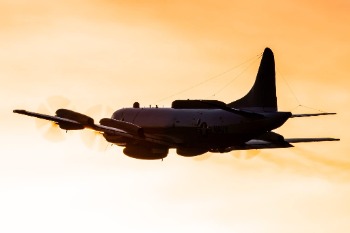
The last EP-3E Aries II was retired by VQ-1 on 12 February 2025 after the type’s 45 years of service to the fleet. The day after BuNo 159893 was flown to Davis Monthan AFB where it is now stored at AMARG together with the others. BuNo 159893, was the last of 26 EP-3Es that served the fleet beginning in 1970. Ten P-3A Orion patrol aircraft were converted to EP-3Es for operation by VQ-1 and VQ-2, joining two earlier EP-3B versions in service. This batch of EP-3Es were replaced beginning the 1990s by a new generation of EP-3Es converted from P-3C Orions, with ultimately 17 aircraft converted to sustain an operational fleet of 12 aircraft. On 20 February 2025 the retirement ceremony was held for the very last Whidbey based P-3C BuNo 161588. It also was flown to AMARG the day after. On 28 March 2025 the decommissioning ceremony of VQ-1 took place at NAS Whidbey Island, WA.
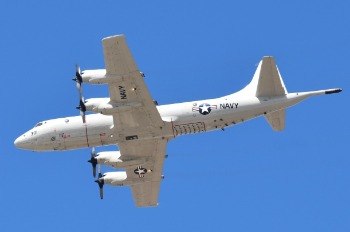
After the retirement of VQ-1’s two Orions the remaining number of active US Navy P-3 Orions in April has gone down to 6:
VX-30 150521, 160293, 162999, 163291
VXS-1 158570, 158912
VX-30 operates three P-3C and a single NP-3C (BH341) out of NAS Point Mugu, CA.
On 9 December 2024 BH341 made a nonstop flight from Point Mugu to Muniz ANGB (Luis Muñoz Marín International Airport) on Puerto Rico and the return flight was on 15 December.
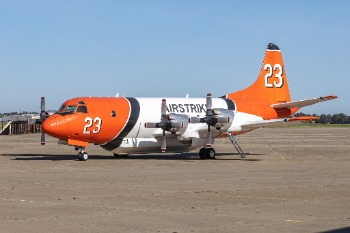
Three former Aero Union / Airstrike P-3A Aerostar firefighters were sold by auction on 22 January 2025 by James G. Murphy Co. All three were still present at Sacramento McClellan Park, CA. The offering described N917AU as "non-operable"; N921AU as "parts only"; and N923AU as a complete aircraft. Time to have a look at what happened to the ten P-3 Aerostars:
N900AU (151391) sold to United Aeronautical Corp in Tucson, AZ
N917AU (150510) sold by auction by James G. Murphy Co. to ?
N920AU (150513) fuselage in yard of UAC in Tucson, AZ
N921AU (151385) sold by auction by James G. Murphy Co. to ?
N922AU (151387) Buffalo Airways USA
N923AU (151372) sold by auction by James G. Murphy Co. to ?
N924AU (151359) flew into a mountain near Florence in Montana
N925AU (151361) MHD Rockland stored Keystone Heights
N926AU (152731) crashed in an open area 12 mile north of Chico, CA;
N927AU (151369) MHD Rockland stored Keystone Heights
The ‘Aerostar’ fire-fighting conversions were carried out for Aero Union at Chico, CA in the early 1990s, the aircraft having a 3,000-gallon retardant tank fitted. Five were parked up at Sacramento McClellan Airport, CA. waiting for a new owner following the shutdown of Aero Union in 2011. Eight Aero Union Aerostars were purchased by a company that primarily deals in supplying and overhauling spare parts for aircraft United Aeronautical Corporation (UAC), headquartered in North Hollywood, CA. Of the eight P-3’s UAC acquired, T-22 was sold to Buffalo Airways, T-20 is in Tucson scrapped, while T-00 was last seen (without its props).at Chico Regional Airport (together with T-25 and T-27) in December 2023, with MAFFS Protection from above titles. Airstrike Firefighters LLC, purchased the remaining five Aerostars and has sold two to MHD Rockland (T-25 and T-27) in April 2024 and three by auction.
NOAA WP-3D, N42RF, ‘Kermit’, was deployed to Shannon, Ireland on 18 January 2025 to monitor the storm Éowyn approaching Ireland on Friday 24 January. Kermit stayed up to 3 February.
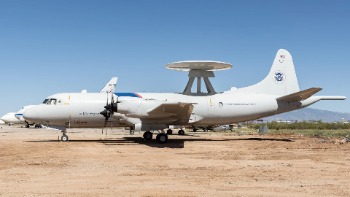
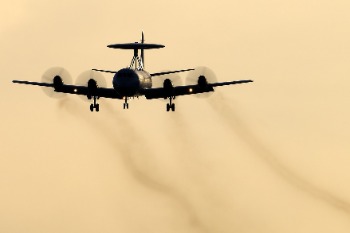
On 28 January US CBP sent one of their AEW P-3B to Davis Monthan AFB for storage at AMARG. In April 2025 only three examples remain:
N142CS
N143CS used for spare parts Sep 2024
N144CS to AMARG 28 Jan 2025
N145CS to Pima museum 9 Sep 2023
N146CS
N147CS sold to Elite One Transportation Sep 2024
N148CS used for spare parts Sep 2024
N149CS
Argentina
The second P-3C (3297) for the Argentine Navy was taken out of storage during December 2024. It was flown from Davis Monthan to Keystone Heights City-Airport in Florida where ESG Aerosystems, provides training to Argentine pilots and FEs for proficiency. The third P-3C (3298) is expected during 2025 while the final P-3N (4576) will be delivered in 2026. In April both aircraft were no longer mentioned in the monthly AMARG inventory list.
Canada
The eleventh Block IV Aurora 140101 was delivered to 14 Wing at CFB Greenwood in February 2025. The twelfth and final Block IV is 140117, which was delivered in April 2025.
Between 3 and 14 March 2025 CP-140M’s 140101, 140113 were participating in the NATO exercise Dynamic Manta 2025, operating out of NAS Sigonella. On their way back home, both Aurora’s made a stopover at Prestwick airport. On 3 May Auroras 140111 and 140113 were noted at Keflavik to take part in exercise Dynamic Mongoose.
Chile
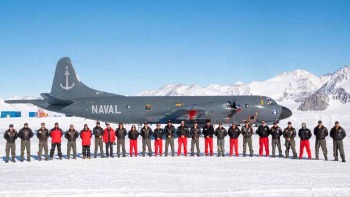
On 13 December 2024 VP-1 landed one of their two P-3ACH (407) in Antarctica.
Germany
From early March to 17 March P-3C 60+04 was deployed to NAS Sigonella to participate in the NATO exercise Dynamic Manta 2025. On 16 April this same aircraft made one touch and go visit at Eindhoven AB in the Netherlands. The flight came from Nordholz and returned to base via Leipzig. On 25 April 60+04 arrived at RAF Lossiemouth totake part in exercise Dynamic Mongoose. The Malta Aviation Society has announced that a German P-3C will be present during the annual Malta International air show on 27 and 28 September.
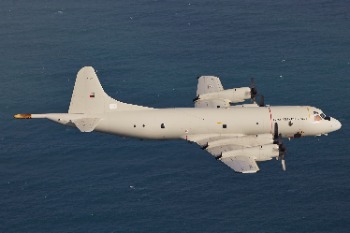
In April 2025 the situation of the remaining five German Orions was the following:
60+01 wfu Nordholz; will go to the Aeronauticum museum at Nordholz
60+02 wfu Manching stored with WTD.61; will go to the NMM at Soesterberg as 302
60+03 operating out of Nordholz; sold to Portugal
60+04 operating out of Nordholz; sold to Portugal
60+22 will be gate guard at Nordholz
Greece
On 25 March P-3B 152744 was one of many aircraft that participated in the annual fly-past over Athens. This event is to commemorate the anniversary of the 1821 War of Independence. So far, no news on another Greek P-3B to be modified.
Japan
During December 2024 the crew of a JMSDF P-3 discovered a new Russian Kilo II submarine, while flying a mission over the Pacific Ocean.
Portugal
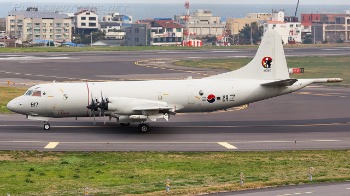
On 12 December 2024 P-3C CUP+ 14809 of 601 Sqn departed from NAS Sigonella and so ended its support the NATO operation “Sea Guardian”
601 Sqn once again deployed a P-3C CUP+ to the Baltic states on 5 April, when 14809, was flown to Ämari air base, in Estonia. The aircraft returned home on 6 May.
The third Block I P-3C 14810 returned to Beja on 18 January 2025, after the fourth aircraft 14807 had arrived at Halifax. On 9 April the fourth Block I P-3C 14807 returned to Beja.
14807 Block I (4) January 2025 9 April 2025
14808 Block I (1) October 2023 28 March 2024
14809 Block I (2) May 2024 26 September 2024
14810 Block I (3) 16 September 2024 18 January 2025
South Korea
A RoKN P-3CK Orion crashed near Pohang on 29 May, when it was practicing touch-and-goes with a crew of four. The aircraft, tail number 100917 (ex USN P-3B 153416) crashed six minutes after take-off and after completing the first touch-and-go in a planned series of three. Video footage from a security camera showed the aircraft in a turn, then stalling and departing from controlled flight. All four onboard, two pilots and two flight engineers, died in the crash. They were assigned to 615 squadron at Jeju, but deployed to Pohang for training. The South Korean navy has grounded the remaining 15 P-3C and P-3CK Orions pending the outcome of the investigations to the cause of the crash.
The Netherlands
The “Stichting Behoud Lockheed Orion 302” (Foundation for the Preservation of Lockheed Orion 302) was established in November 2024 with the goal of adding the former Dutch maritime patrol aircraft P-3C Orion 302 to the collection of the National Military Museum (NMM) in Soesterberg, The Netherlands. Led by retired Vice Admiral Erik Kopp, the foundation has conducted feasibility studies to assess the restoration and acquisition process. The plan is to restore the aircraft to its original P-3C Update II.5 configuration, in which it served until 2004 with the Royal Netherlands Navy. The aircraft was transferred to the German Navy in 2006 after an upgrade and has been out of service since 2020. It is expected to become available for acquisition soon. New Zealand has offered spare parts from its decommissioned P-3K2 fleet, but the foundation is still seeking engines and propellers from donors across Europe. The purchase depends on approval from both the German and U.S. governments, which is still pending. If approved, the aircraft will be dismantled and transported by road in 2026. The restoration process will include vocational training opportunities in The Netherlands and will be supported by experts in sheet metal and composite work. Funding will be partially covered by a donation campaign launching this summer. Stay updated by visiting the foundation’s website: www.orion302.nl. Support has already been received from the Stichting Koninklijke Defensiemusea (the parent organization of NMM), the Karel Doorman Fonds, and limited manpower aid through the Dutch Ministry of Defence. Once restored, the aircraft will be transferred to the NMM and put on public display by late 2027 or 2028, joining its predecessors-the Lockheed SP-2H Neptune and the Breguet Br.1150 Atlantic-as a tribute to those who served in anti-submarine warfare.